Principles of Eating Healthy · included with Ask Fernando
Module 1 — The Sweet 16
The Sweet 16 is a checklist for judging any meal. Sixteen questions you ask about what’s on the plate. Four of them are non-negotiable — fail one and the other twelve can’t rescue it. This module teaches all sixteen, then gives you two tools to run them on your own dinner.
Introduction 1 of 9
Principles of Eating Healthy
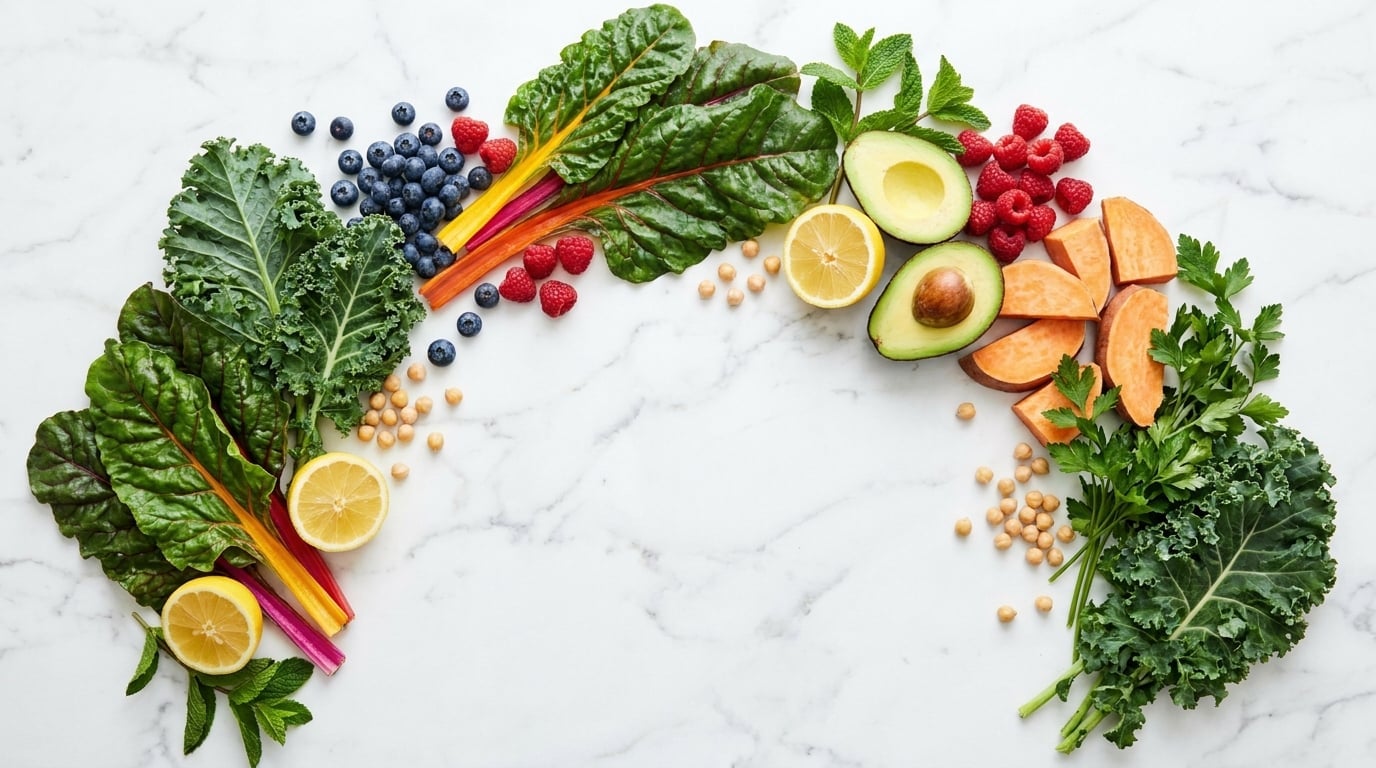
Most people already know that vegetables are good for them. That has never been the problem. The problem shows up at six in the evening, in front of an open refrigerator, tired, with about four minutes of patience left. Here is a version of it most people will recognize: someone who believes they are eating healthy because they chose the chicken instead of the beef on a fast food menu, or the apple slices instead of the french fries. The intention is real. What is missing is any way of knowing what the body will actually do with either plate.
That is the real gap — not the one between good food and bad food, which you can already sense, but the one between caring about your health and being able to look at a specific meal, on a specific evening, and say what it will do to you.
Principles of Eating Healthy is a course about reading a plate. By the end of it you will be able to take any meal — the one you cooked, the one you ordered, the one your mother made — and assess it deliberately: what it gives your body, what it costs your body, and which one or two changes would improve it most. That is a skill, not an opinion, and it can be taught. Module 1, The Sweet 16, is where it starts.
Energy is the thing underneath everything
Open any large pathology textbook and read the symptom lists. Fatigue appears in almost all of them — above ninety-nine percent of disease processes — and that is the most useful fact in medicine rather than trivia. If nearly every condition drains a person’s energy, energy production is not one concern among many; it is the floor everything else stands on. A body short of energy cannot supply its immune system, repair tissue, detoxify, digest well or think clearly. Restore the energy first, and you get to see what the body can really do.
That energy is made in your mitochondria, the small structures inside your cells that turn glucose into ATP — the same thing older traditions call chi, or prana, or the vital force. They are quick about it: a molecule of ATP is assembled roughly a thousand times faster than you can blink. But they are not magicians. They need B vitamins, magnesium, iron, copper, sulfur, oxygen and a slightly alkaline environment around them. Give them those and they work. Withhold them, or bury them under stress and inactivity, and production falls off. This is the most common oversight in health plans of every kind — careful plans that never ask whether the person has the raw materials to make energy at all.
This is why the body is said to heal itself. Not mystically. It means that if you give the body what it needs — the nutrients, the rest, the space, the reason — healing is most often what it does on its own, without further instruction.
Which brings us to food. A food’s chemistry outside your body tells you very little about what it does inside. A lemon is strongly acidic on a pH meter; swallow it, and the bioflavonoids, antioxidants, vitamins and minerals it carries have an alkalizing effect on your blood. Food is information, and the body reads it after you swallow. What matters is the net effect: does this food arrive carrying nutrients your body can use or store, or does it arrive empty, forcing your body to spend reserves to bring itself back into balance? Think of it as a bank account. Nutrient-dense organic food is a deposit. Fast food, refined sugar, pesticide-heavy produce and feedlot meat are purchases on credit, and the credit runs out. Which means eating well is not really about eating. You are not what you eat; you are what you can absorb.

What the Sweet 16 actually is
The Sweet 16 is a checklist of sixteen questions you ask about a meal. It was built by studying why various diets work when they do work — paleo, Atkins, all of them — and pulling out the principles underneath rather than the branding on top. They ask whether the meal contains a green food, whether it is rich in antioxidants, whether it holds under eight grams of refined sugar, whether it delivers eight to twelve grams of fiber, whether anything on the plate is raw, whether the oils were used at the right temperature, whether the meat was clean and the fish wild, whether the cookware leaches anything, whether anyone you love helped prepare it, whether your drink was small and warm, and whether you can burn off the calories that same day.
Four of the sixteen are non-negotiable. A meal has to supply the nutrients needed for energy production, be organically sourced, be free of your own delayed food allergens, and be at least sixty percent alkalizing — seventy to eighty is better. If any of those four are violated, forget it; it is not an eating-healthy meal, however many of the other twelve it satisfies. The remaining twelve are not decoration — antioxidants, fiber, raw food, preparation method and clean meat come very nearly as important — but the four are the floor, and everything above them is what takes a decent meal and makes it a good one.

How this course works
You read, then you apply it to your own dinner. That is the whole method. Each lesson gives you one piece of the mechanism and one thing to do with it tonight, using food you already have. There is no shopping list to buy your way into and no eating plan to fall off. Two tools do the arithmetic alongside you: one walks a real meal through all sixteen questions and flags any of the four minimums it fails; the other works out the net effect of what is on your plate, so you can see whether you actually cleared sixty percent alkalizing or only feel as though you did. Use them on meals you really ate.
Give it time before you judge it. Give any change a minimum of twenty-eight days before you assess it, because the body needs that long to learn how to use what it is being given. Your first few assessments will probably be uncomfortable. That is information, not a verdict on you.
Where this material comes from: the therapeutic ranges and food rankings taught here draw on clinical texts, published research and observations from more than three and a half thousand documented cases. The aim of the course is the same as the aim of a good practitioner — to become unnecessary. Not because nobody could help you, but because you understood enough to look after your own household yourself. That is why it is included with Ask Fernando rather than sold as a separate thing: the numbers Ask Fernando holds and the food on your table are the same subject.
Energetic health is easier to feel than to argue with. It is what life feels like when you are at your best.
Most people have never had a sustained experience of that, and have quietly concluded that how they feel now is simply how they are. It usually is not. Start with your next meal, whatever is in the house. Bring it to Module 1 and run it through the Sweet 16.
Lesson 2 of 9
Why four come first

Stand in your kitchen for a moment. Whatever you were about to make, leave it on the counter. Before you decide whether it is a good meal or a bad one, there is a prior question, and it comes first: what is this food actually for?
Most of us have been trained to answer that question with a number. Calories. Grams of protein. Points on some app. But those are accounting terms, and the body is not an accountant. There is a different definition, and once you have heard it you cannot really go back to the other one. Nutrition is giving your body — and more specifically the mitochondria you’ll find within each of your cells — everything they need to produce energy.
That is the whole thing. Not weight. Not appearance. Energy.
The powerhouses, and how much they are asked to do
Mitochondria are small organelles inside your cells. A single cell might hold just one of them, or it might hold as many as ten thousand. The densest populations show up exactly where you would expect if you thought about it for a second: in muscle tissue like the heart, and in nerves, especially around the eyes, where there is enormous activity and a constant traffic of neurotransmitters to process.
What they make is ATP — adenosine triphosphate. In Western science it is described as the end point of a series of biochemical transformations, thirty-three of them, turning glucose into ATP. In Eastern traditions the same thing gets called qi, or prana, or the vital force. Those are the same phenomenon described by two vocabularies, and something in the pairing is worth noticing: the East says it is the air we breathe and the food that we eat, in that order. The West puts food first and air second. The East never underestimates breathing. Neither should you, because without oxygen your mitochondria cannot make energy at all.
Now, the two numbers that ought to reset how you think about a meal.
The first is speed. A mitochondrion can produce one molecule of ATP in six hundredths of a millisecond. Blink your eyes. That blink took somewhere between three hundred and six hundred milliseconds. Your body can make a molecule of energy roughly a thousand times faster than you can blink.
The second is volume. Take your current body weight and double it. That is the weight of ATP your body is designed to create every single day. Not once. Every day. A high-performance athlete makes somewhat more than that. And if you are fatigued — genuinely, persistently tired — then you are making less.
Sit with the scale of that for a second. Twice your body weight, manufactured and spent, between waking up and going to bed. That is the production line your meal is either supplying or shorting.
Why fatigue is the thread
Here is where the argument turns, and it is the observation that organizes everything else this course teaches.
Every physiologic balance in your body requires energy. Every biochemical enzyme that helps with detoxification or supports an individual organ requires energy. Every thought — because thoughts are built on neurotransmitters — requires energy.
So look at what happens when energy production drops. The pattern is blunt: the number one common symptom among all disease processes is fatigue. Not a symptom that shows up often. The one that shows up in every case. There is not a pathology that does not list fatigue or malaise somewhere among its symptoms.
Read that as a clue rather than as bad news. If fatigue is the universal companion of illness, then energy production is the universal lever. Address the fatigue and you have not merely treated a symptom — you have restored the capacity the body uses to fix everything else. Give the mitochondria what they need, in the therapeutic amounts they need it, and they produce energy. That energy becomes enzyme production inside the cell. Those enzymes support repair of the cell, detoxification of the cell, and the cell’s ability to do its actual job. A liver cell detoxifies. A lung cell brings oxygen in better and clears carbon dioxide better. A nerve cell conducts its bioelectric potentials better. The body is designed to heal itself and will do everything it can to do so.
And this is the gap in practice — across every system, conventional and natural alike. The biggest error in healthcare today is that people are not paying nearly enough attention to mitochondria, and to the nutrient requirements mitochondria must have satisfied to do their job. There is an assumption baked in everywhere that the body already has what it needs to make energy, so the problem must be somewhere else. Usually it is exactly the opposite.

What this makes non-negotiable
Now come back to your kitchen counter, because the argument has a practical edge.
The Eating Healthy Sweet 16 was built by studying diets that worked and asking why they worked. Not from the standpoint of anybody’s personal goal — not weight loss, not looking better — but from the standpoint of how the body would see a dietary approach working. Sixteen questions you can ask of any meal. But the sixteen are not a flat list. The first four sit apart from the other twelve, and by now you can probably see the reason yourself.
The first four are the ones that determine whether the meal supports energy production at all.
It has to contain the nutrients required for energy production — even if some of those come in supplementally. It has to be organically sourced, because that is how you avoid the pesticides and GMOs that damage the machinery you are trying to feed. It has to be free of delayed food allergens, which are acidifying and force the body to spend rather than deposit. And it has to be at least sixty percent alkalizing, preferably seventy to eighty.
Alkalinity is not an aesthetic preference here. Your bloodstream is designed to sit at roughly 7.35 to 7.45, slightly alkaline, and so are many of the most important energy-producing tissues. That is not a coincidence, and the purpose is plain: alkalinity supports mitochondria producing more ATP. That is what it is for. When you eat something acidifying, the body has to compensate, and compensating drains energy. An organic, nutrient-dense meal is money into your savings account. Fast food, GMOs, pesticide-laden produce, CAFO meat — that is working on credit with your health, and the credit eventually runs out.
So the reason the first four gate the other twelve is not strictness for its own sake. It is that the other twelve are refinements of a meal that is already feeding your mitochondria, and a refinement of nothing is still nothing. A meal can hit twelve of sixteen and still be built on conventional produce and feedlot meat, and that meal has not earned the name. If any of the first four are violated, forget it.
Which is oddly freeing. You do not have to memorize sixteen rules before dinner. You have to clear four, and then you get to improve from there.
Lesson 3 of 9
The sixteen questions

The Sweet 16 came out of a simple habit: when a diet works for somebody, find out why. Paleo works for some people. Atkins works for some people. Rather than pick a camp, the work went looking for the principles underneath the ones that worked, because genetic individuality means no diet is one size fits all — but there are principles that by and large do work for people across the board.
What follows is not an ideology. It is sixteen questions you can ask of a plate. They are grouped into four sets of four, and the grouping carries most of the meaning.
One through four: the gate
These four are not preferences. A meal that fails any one of them is not an eating-healthy meal, regardless of how it scores elsewhere.
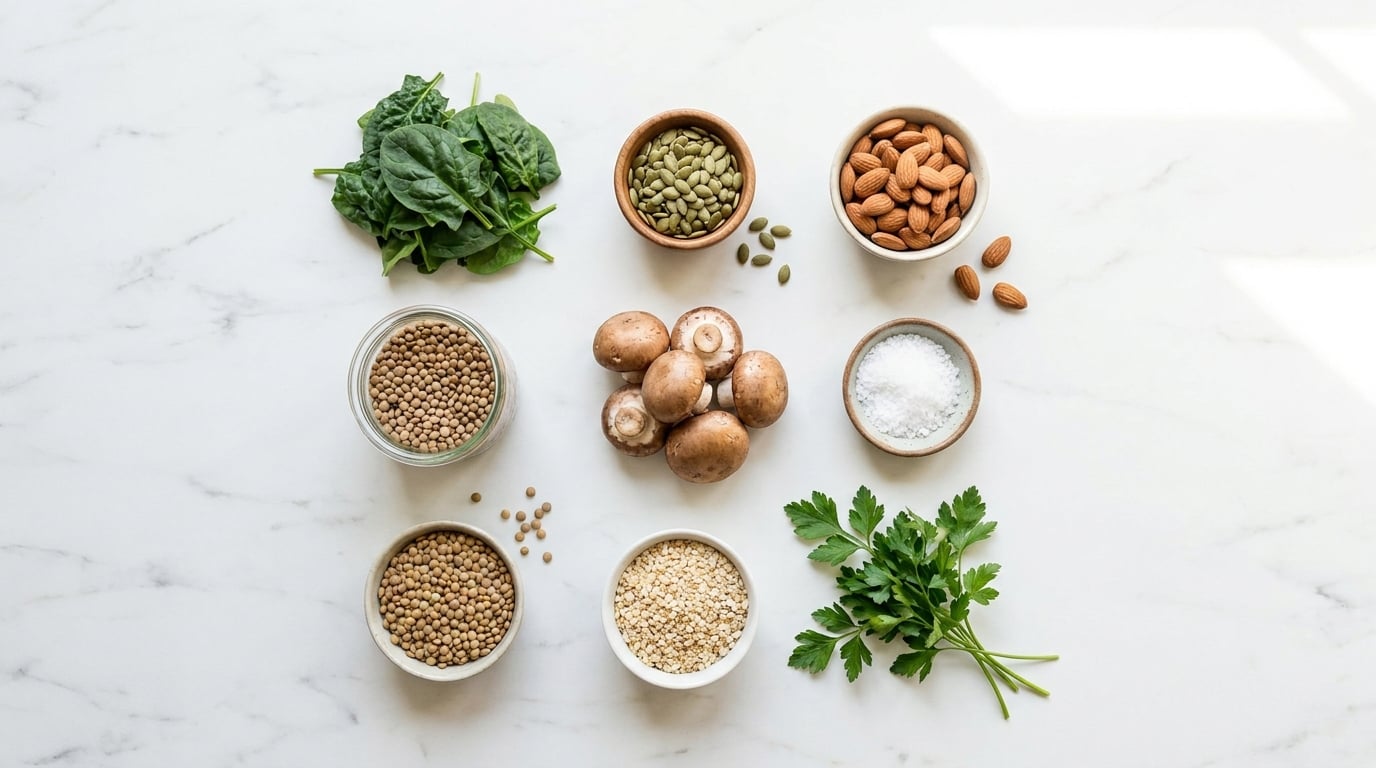
Does the meal contain the nutrients required for energy production? This is the whole point of eating. Mitochondria need particular B vitamins and particular minerals — copper, magnesium, iron among them — plus oxygen, to run the transformations that end in ATP. Some of those nutrients can be provided supplementally. What is not allowed is the meal that supplies none of them.
Is it organically sourced? Organic is doing two jobs at once. It removes what harms you — GMOs, pesticide residue — and it raises nutrient density. Both matter, but the first matters more than most people realize. Pesticides are designed to shut down acetylcholinesterase, the enzyme that clears the neurotransmitter acetylcholine out of the synapse. That is how they kill insects. It is not an effect that politely stops at the species boundary. And organic sourcing is also a vote: every dollar you spend is a vote cast, and corporations respond to money far more reliably than to protest.
Is it free of delayed food allergens? A delayed food allergen does not announce itself with a rash at the table. It shows up hours or days later as fatigue, fog, aching, poor sleep. Its net effect on the body is acidifying — it costs you reserves rather than depositing them. This is one reason people who quit grain feel better within weeks. They were reacting, and they stopped.
Is it at least 60% alkalizing — preferably 70 to 80%? One clarification saves a lot of confusion here. The plus-four to minus-four ratings are not literal pH readings. They are a ranking of net effect: what a food does once it is inside you. A lemon is acidic on the outside. Bring it in, let it meet your enzymes, and the bioflavonoids, vitamins and minerals that ride along with it make its net effect alkalizing. The working definition is worth memorizing: a food is alkalizing when it imparts nutrients for immediate use or storage, and acidifying when it brings nothing and forces the body to spend its own reserves to restore balance.

Five through eight: the alkalinity amplifiers
Past the gate, these four push a decent meal toward a genuinely good one.
Does the meal include at least one green food? You can eat a healthy meal without one. You would still be better off not. Chlorophyll helps build new blood and raises the alkalinity of the bloodstream, which is why the standing instruction is simply: eat something green every day.
Is the meal rich in high-ORAC antioxidants? Treat this one as near-mandatory. It belongs with the first four in any honest list of the real minimums. The reason is that being alkaline and being a rich source of antioxidants go hand in hand — they are two descriptions of the same quality. Antioxidants protect cells from damage, and protected cells produce energy. A related detail worth knowing: among herbs, the ones with the highest antimicrobial effect also tend to have the highest antioxidant capacity.
Does the meal contain less than eight grams of refined sugar? Do the arithmetic. Four grams of sugar is one teaspoon. The body’s actual requirement is roughly one teaspoon every two hours. So eight grams is already two teaspoons — a target, not a license. Past that, even in dessert, you are creating acidity and making the body work harder than it needs to.
Does the meal include something naturally sweet? Not a contradiction of the last one. Energetically, the sweet flavor inspires calm, clear, rational thought, and we need some sweetness in our lives every single day. Food is a beautiful way to deliver it — provided it arrives organic, and often raw and naturally sourced, rather than refined.
Nine through twelve: how the meal is built
This block is about construction — fiber, enzymes, heat, sourcing. Numbers nine, eleven and twelve sit among the handful that are close to non-negotiable.
Does the meal have eight to twelve grams of total fiber? This one is huge, and the reasoning is worth understanding rather than just complying with. Fiber slows digestion down. Slowing digestion down is not a cost, it is the point: it gives the body time to actually absorb the nutrients you paid for. It also clears out waste and helps you poop. This is a meal standard, incidentally, not a snack standard.
Does the meal include a raw fruit or vegetable? Something raw brings enzymes with it. Note what is not being said. This is not an argument for the hundred percent raw diet — people who come to that ideologically run into a lot of problems. Raw food is excellent as an incorporated part of the diet. One raw component per meal is fair.
Is the meal prepared using healthy preparation methods? Mostly this comes down to matching the oil to the temperature. Olive oil should be treated as a no-heat oil: apply a little heat and it can turn into a trans fatty acid. If you did not know that, you are in large company. Sunflower oil is a better choice where heat is involved, and there is a whole slew of oils better suited to heat than olive. If meat is part of the meal, has it been marinated? Is it cooked at low temperature? These are small handling decisions that quietly determine what arrives in your body.
If you are eating meat, is it environmentally safe? Meaning organic, and meaning not the product of a CAFO — a confined animal feeding operation. For fish, meaning fresh rather than farmed. Farmed fish are confined by the thousands in a single net, so disease runs through them; their feed can carry PCBs and plastics; and they never get their natural diet. With salmon there is an extra layer — the flesh is dyed after harvest so you do not see the gray it actually is. There is even a color fan used to choose the shade.
This is also where the one real caution about paleo belongs. Someone who drops grain often feels great, and probably was allergic to the grain. But they frequently trade one problem for another: a great deal of meat, high in arachidonic acid, and typically not from clean sources. Better in the short run, not a winner over the long one.
Thirteen through sixteen: the conditions around the meal
The last four are about everything that is not the food itself — what it was cooked in, who you ate it with, what you drank, and what you did afterward. Number thirteen is enormous, alongside eleven and twelve.
Is the meal prepared using environmentally safe cookware? Teflon is no good. Non-stick coatings generally are no good. The question to ask of a pan is what it will leach into your food. Cast iron leaches iron, which is a nutrient your mitochondria need. Lead-free ceramics leach nothing. You did the work of sourcing organic ingredients; do not hand them to a surface that undoes it.
Are family and friends involved in the preparation — or are you doing this alone? Be direct with yourself about this one. Food is a communal event. It is designed for that, and it is a great time to create community. Eating alone, meal after meal, is not a neutral condition for the human body.
Is the beverage with your meal eight ounces or less, and is it warm? Both halves matter, and both for the same reason: you do not want to suppress the digestive fire. A large cold drink alongside dinner dampens the very process you are relying on to extract what you just ate.
Can you burn off all the calories in the same day? The last question is the simplest. Anything you do not burn accumulates — as fat deposits, as weight, and then as a decline in how you feel about yourself and how you feel generally.

How to actually use this
You do not need all sixteen for a meal to count. That is said plainly. What you need is one through four, without exception — violate any of those and the rest is beside the point. Beyond the gate, the absolute minimums are six, nine, eleven, twelve and thirteen. Everything else is a beautiful bonus.
Do not optimize for the bare minimum. The difference between hitting the minimums and ticking off most of the sixteen is the difference between a day that comes out plus-two or plus-three alkalizing and one that lands at plus-three or plus-four — which sets up your moods for the rest of that day and into the next one.
Do this week
- Take the questions to your actual dinner.
- Ask how many of the sixteen it satisfies.
- Then change one thing.
- Give any change at least twenty-eight days before you judge it, because the body needs somewhere between seventeen and twenty-eight days to figure out how to use what you are giving it and to prosper from it.
That is not a long time for something that has to last you.
Exercise 4 of 9
Score a meal

Think of the last real meal you actually ate — not an ideal one — and tick what was true of it. The first four are the gates. Miss any one of them and the total does not matter.
Start ticking.
Most people score lower than they expect the first time, and it is almost always one of the first four that fails. That is the useful part.
Lesson 5 of 9
Net effect, not face value

Cut an organic lemon in half, squeeze it into a glass, and drop a pH strip into the juice. It will read somewhere around 2.0. On the standard pH scale, where seven is neutral and zero is battery acid, that is strongly acidic. And yet the lemon is one of the more alkalizing things you can put into your body. Both of those sentences are true at the same time, and learning to hold them together is the whole of this lesson.
What the strip measured was the lemon sitting on the counter, separate from you. That number tells you about the juice. It tells you nothing about what happens once the juice is inside a living body. Because the lemon does not arrive alone. It brings its bioflavonoids, its vitamins, its minerals, and all of that meets your own enzymes and your own tissues. Everything the organic lemon carries with it helps the body turn the encounter into an alkalizing experience. This is net effect pH: not what a food is, but what it does once your body gets hold of it.
This is a real break from how the acid-alkaline idea used to be taught. The old approach came out of the early 1900s and was called potash theory. Researchers burned foods down, measured the ash, and sorted what was left into alkali salts and acidifying elements. It was a reasonable thing to try with the tools of the day, but it is not what we are capable of knowing now. The net effect model asks a different question. What is the sum of all the antioxidants, all the minerals, all the nutrients — and all the chemical residues — that this food carries into a body, and where does the body end up after it has dealt with the whole package?
Why the countertop does not get a vote
To understand why the net effect is the only thing worth measuring, you have to know how narrow the body’s tolerance actually is. Your blood is designed to sit between 7.35 and 7.45. That is the number every other tissue in you keys off. Some tissues are meant to be acidic — stomach acid runs at 1.2 to 2.0, urine and saliva sit around 6.0 to 6.8 — and they can only build that acidity because the blood is supplying them from a stable alkaline baseline. Blood creates and promotes life. The acidic fluids protect it. They work as a pair, and the pair only works if the blood holds its line.
You will meet people who insist blood pH simply cannot leave that range, that there are too many safeguards. This gets challenged often. But arterial blood gas draws show means of 7.22 and 7.38, and in some groups 7.27 and 7.11. It happens. Eat a fast food meal and your bloodstream turns acidic for a while — possibly down as far as 7.11 — until the safeguards can haul it back up.
Here is what one of those safeguards costs. When tissues go acidic, a chloride ion moves into a red blood cell and a bicarbonate ion is pushed out. Bicarbonate is strongly alkalizing, so the blood pH comes back up. But look at what is now sitting inside the red blood cell: a hydrogen ion and a chloride ion. Together they are hydrochloric acid — stomach acid — inside a cell that was never built to hold it. The cell is damaged in the act of rescuing you. It becomes a buffer, and it pays for that with its own life.
That is what is actually at stake when we talk about a meal being acidifying. Not a number on a chart. Cells spent to cover the difference. Acid does one thing: it causes damage. Damage has to be repaired, repair takes energy, and by definition that is a stress on the body. And the way you help those red blood cells is not complicated. Eat something green and organic every day, and breathe. Oxygen is the single most alkalizing substance the body can receive. Chlorophyll is second.

The +4 that lands at −4
Now the part that catches most people out. You look at a potato, or an apple, or a bag of spinach, and you think: produce, plant-based, plus four. Conventional produce is a minus four.
The reason is in the architecture of a plant cell. Plants have no bloodstream, no lymph, no sweat glands. They cannot move waste around and push it out the way you can. So when the roots take up whatever is in the soil — nutrients, water, and pesticide residue alike — the plant isolates what it cannot use in a structure called the central vacuole. That is its holding tank. Plants were never intended to be grown in toxins, so they never needed a robust detoxification system, and they do not have one.
Which means the residue is not on the plant. It is in it. When you chew, you break the cell walls open and liberate everything inside — the chloroplasts and their antioxidants, which is what you want, and whatever is sitting in the vacuole, which is not.
So the net effect of a conventionally grown vegetable is that your body has to work harder to undo the damage than it gains from the food. It scores where the damage puts it, not where the food group sits. And it is worth remembering what pesticides are. They were developed for war, and judged inhumane enough in warfare to be banned there. They were not banned on food.
A scale of its own: −4 to +4
The net effect scale runs from +4, the most alkalizing, to −4, the most acidifying. It is deliberately not the 0-to-14 pH scale, and confusing the two is the single most common error students make. The 0-to-14 scale is logarithmic and describes a substance in isolation. The −4 to +4 ranking describes an effect on a human being. Lemon is 2.0 on the first scale and firmly positive on the second. If you try to calculate with pH values you will never arrive at a usable answer.
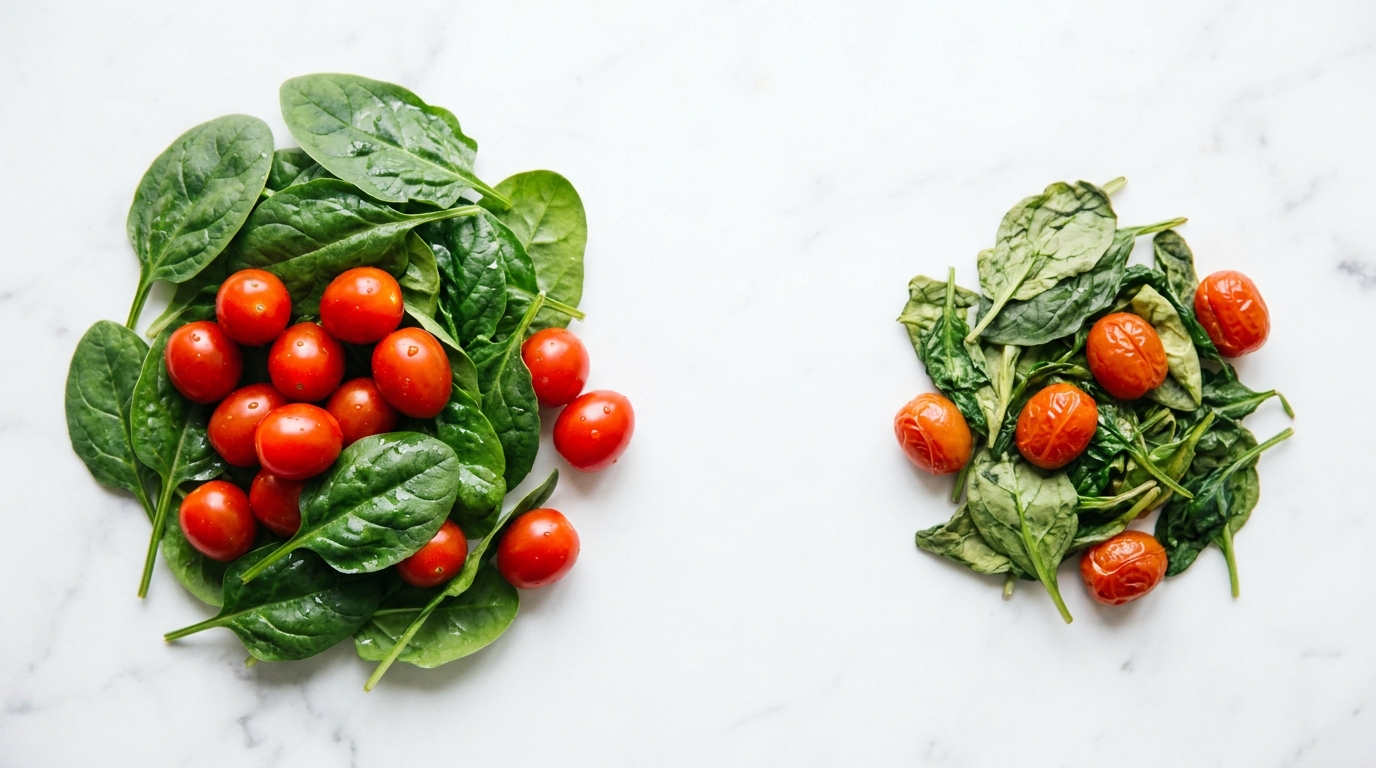
The chart is built on antioxidant capacity and nutrient density — much of it resting on the work of Dr. Ronald Prior, the foremost American researcher on antioxidants — alongside ORAC values and years of clinical observation. Spinach, for instance, carries an ORAC value of 1515. Plenty of herbs run into the hundreds of thousands, but you eat far more spinach than you do a therapeutic herb, so do not be discouraged by the comparison.
Two things sit outside the chart’s ordinary logic. Delayed food allergens are acidifying for the person who is allergic, no matter which column that food normally occupies. And the chart covers lifestyle as well as food: sleep, exercise, whether you sweat, whether you have a breathing practice, whether you are isolated. Those rows are scored the same way.
Sixty percent, and plus ten
Two numbers come out of a meal. The alkalizing number is the sum of the ratings. The alkalizing percentage is the sum of the positive ratings divided by the sum of every rating with its sign stripped off, times one hundred.
Work through the example. The meal is organic turkey bacon, organic blueberries, chlorella, organic unfiltered apple juice, non-organic potatoes and non-organic cow’s milk. The turkey bacon is organic, but it is still a meat carrying arachidonic acid and no antioxidant potential, so it is a −1. Blueberries are +4. Chlorella, a green superfood, is +4 — every chlorophyll-rich green of that kind ranks +4. Apple juice, unfiltered and organic, is +2. The two non-organic items are −4 each.
Add them as they stand: −1 plus 4 plus 4 plus 2 minus 4 minus 4 gives you +1. That is the alkalizing number.
Now the percentage. The positives are 4, 4 and 2, which total 10. Strip the signs from every item and add them all: 1 plus 4 plus 4 plus 2 plus 4 plus 4 gives 19. Ten divided by nineteen, times one hundred, is 52.6%.
The targets are a meal above 60% and an alkalizing number of +10 or better. This meal reaches neither. And look at what it contains: organic berries, a green superfood, organic juice. On a plate it looks like the meal of someone doing well. It is still, on net, an acidic meal. Two of the six items are dragging four full points each in the wrong direction. Swapping the non-organic potatoes and milk for organic ones would move this meal further than adding a single new “healthy” food ever could.
That is the reframe. A healthy meal is not a list of virtuous-sounding items. It is a sum, and the sum can be negative while every name on the list sounds right. More is not better — better is better. Once you can run these two numbers on paper, you can look at any plate and know what it is actually going to do.
Exercise 6 of 9
Run the numbers on a meal
This is the arithmetic from the last lesson, done with you. Every item gets a value from −4 to +4 — how far it pushes you acid or alkaline once digested. Two numbers come out:
- The alkalizing number — every value added together, signs included. Target: +10 or better.
- The alkalizing percentage — the positives divided by everything with its sign stripped off. Target: above 60%.
The meal loaded below is the worked example. Change the numbers, or clear them out and type in what you had for dinner.
Enter a meal above.
The worked example lands at +1 and 52.6% — a meal with organic blueberries, chlorella and organic juice in it that is still, on balance, acidic. Swap the two non-organic items and watch what happens.
Lesson 7 of 9
Eat before you’re stressed

Somewhere around three in the afternoon, something in you asks for sugar. Most people have been taught to read that as a character flaw — a lapse in discipline to be resisted. Read it as information. Your body is not undermining you. It is telling you something specific, in the only language it has, and if you know how to listen you can answer it properly instead of badly.
Start with what a craving actually is. You are not craving a food. You are craving a flavour. The body is intelligent enough to know which flavours live in which foods, and it reaches for a flavour because that flavour cultivates a particular kind of energy it has decided it needs. When you satisfy the craving with an alkalizing food, you let the body restore the balance it was reaching for. When you satisfy it with an acidifying one, you deliver the flavour and destroy the purpose in the same bite.
What stress is doing while you are ignoring it
All stress leads to acidity, and acidity leads to cellular damage. That is the mechanism underneath everything in this lesson. When you get stressed, your body’s pH shifts toward acid, and acid damages things. That is what acid does.
Your body recognises four kinds of stress. Internalised emotions — worrying about a bill, a relationship, your job security, anything that does not feel good and will not leave your mind. Acidic foods, meaning food that is nutrient deficient, infected, or tainted with chemicals. Biomechanical misalignment, where a body that is structurally out of line breathes inefficiently, takes in less oxygen, and turns more acidic for it. And scar tissue — old injuries, old surgeries, old traumas of any nature. A can of soda is a stress. So is a day spent worrying about money.
Acidity then activates sympathetic mode, the fight-or-flight state, and sympathetic dominance makes the body more acidic still. Once that loop is running, what comes out of a person are energy draining reactions: anger, complaining, frustration, judgment, the need to control everything nearby. These are not personality. They are outputs. The moods that follow a meal tend to arrive two to four hours later, which is why you can look at a plate and know with some confidence what will come out of that person by mid-afternoon.
Different emotions land in different places. Frustration and impatience go to the liver. Guilt goes to the heart. Sadness kept inside goes to the lungs. So the person who is reliably frustrated at work is not just having a bad day. They are putting a specific organ under a specific load, day after day.

Why frustration asks for something sweet
Here is where the intelligence shows itself. You get frustrated at work. That affects the liver. And then, an hour or two later, your body says: I need something sweet.
That is not random and it is not weakness. The sweet flavour cultivates clear, calm, rational decision making. Your body is trying to bring your rational mind back online so you can think the problem through and solve it. It is, quite literally, attempting to teach you how to respond to the adversity in front of you rather than react to it.
This is the difference between responding and reacting, and it is the difference an alkalizing state makes. On the acid side of things, people are reactionary — and further out, over-reactive, the ones who are outraged by a small piece of information or offended by an innocuous comment. On the alkalizing side, people respond. Further along still, they anticipate: they see a problem coming, have a solution waiting, and sometimes head it off before it arrives.
The vending machine
So you are frustrated, your body asks for sweet, and you walk to the vending machine and come back with a Snickers bar and a Coca-Cola.
You have satisfied the flavour and defeated the purpose. Those two items dump a large quantity of sugar into you, and that sugar is acidic. You have taken a body that was already out of balance and pushed it further out. The clear, calm, rational mind your body was asking for does not arrive. What arrives instead is another energy draining reaction — in this case, because of the sweetness, the sense of feeling overwhelmed.
Read that sequence again, because it is the whole trap. The craving was correct. The response was wrong. And the wrong response does not simply fail to help; it manufactures a second problem on top of the first. This is how an afternoon comes apart, and it is why so many people finish the working day worse than they started it and conclude that the job is at fault.

Pre-programming
The fix is not willpower, because willpower is the wrong tool for a body making an intelligent request. The fix is to decide in advance. Call it pre-programming.
It works like this. You know where your stress happens. If it happens at your job, and you are going back to that job tomorrow, then you already know the adversity is coming. You already know you will get frustrated. You already know that an hour later your body will ask for something sweet. Every part of that sequence is predictable. So ask the only question that matters, and ask it the night before rather than at three in the afternoon: what can I have at my desk that is sweet and still alkalizing?
Answer that once and put the thing where the stress happens — the desk drawer, the bag, the car. Then when the frustration comes and the craving follows, you eat what you planned. The sweet flavour stimulates the spleen and pancreas, the clear, calm, rational mind comes online, and you solve the problem you are actually facing. The alkalinity created by the food is what sustains that response. Sweetness alone will not do it; sweetness plus alkalinity will.
Notice what this asks of you. Not restraint, and not going without. You still get the sweet. You are simply refusing to let a vending machine answer a question your body asked in good faith. Stress does not have to follow you home, and a stressful environment does not have to leave you stressed.
None of that requires the environment to change. It requires you to anticipate the stress — and there is no shortage of stress on the planet these days — and to use food as a medicine that both nourishes the body and stabilises your ability to respond.
Do this week
- Notice which energy draining reactions you feel when you are stressed, and which flavour you reach for afterward.
- Work out what the alkalizing version of that flavour is.
- Put it where you will be standing when the moment comes.
The reactions you have been treating as your temperament are, in large part, an output you can change. Your body has been telling you what it needs the entire time. It has just been asking in a language nobody taught you to read.
Lesson 8 of 9
Staples and indulgences
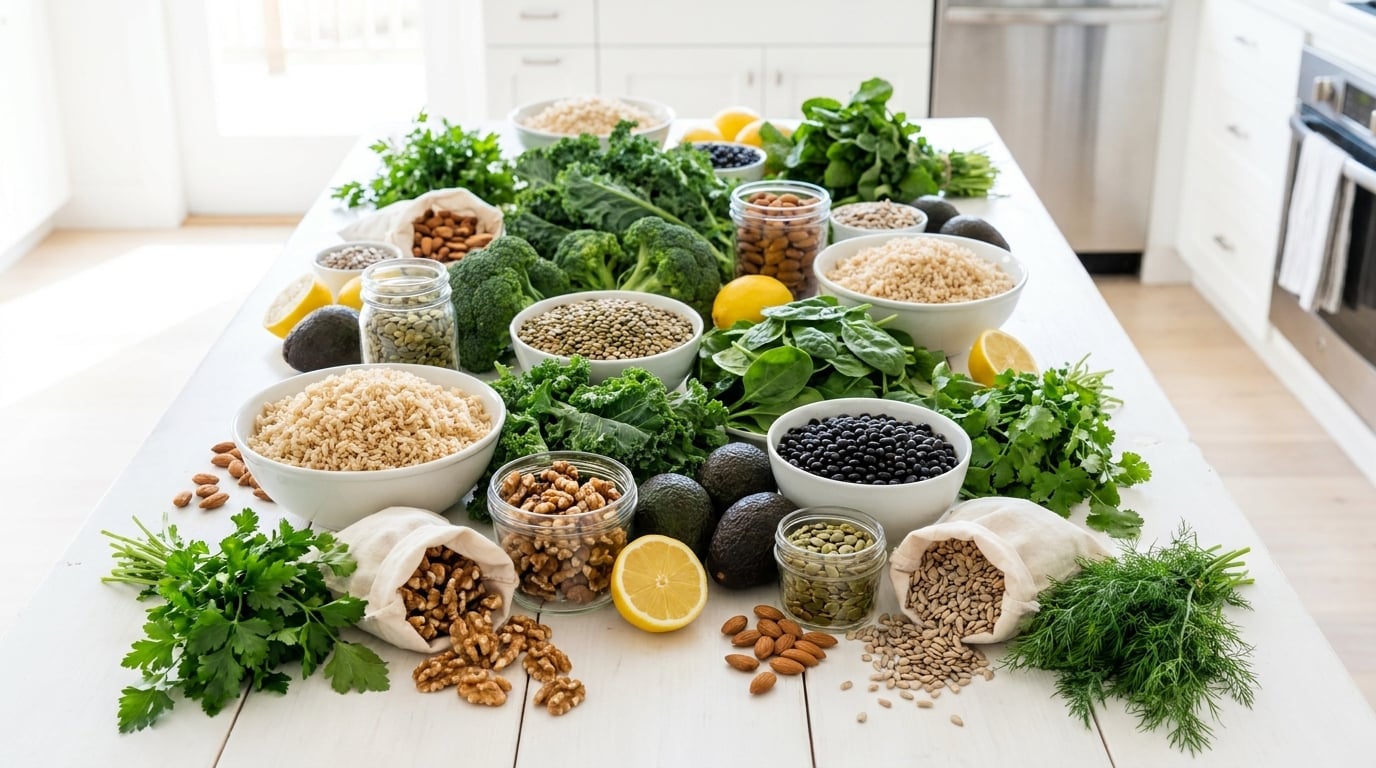
Here is a story you hear some version of almost every week. Someone cleanses for twenty-seven straight days. They are disciplined about it. They do everything right — the foods, the timing, the supplements, all of it. Then on the twenty-eighth day they have a glass of wine. Or a piece of chocolate cake. Or they eat something that showed up on their food allergy report. And the moment it is done, the fear arrives: I have just wrecked twenty-seven days of work.
The answer is flat and unhesitating. It is not possible. One day is never strong enough to undo weeks of work.
That is the foundation of the whole teaching concept, and it is worth sitting with before you learn any of the rules. Because the second fear runs right alongside it. Walk someone through their delayed food allergy report — pulling out the high reactives, the moderate reactives, making judgment calls on the low ones — and you can watch it move across their face. You are taking this away from me. Will I ever be able to have it again? And the answer there is also yes. After a clearance period, typically one to two months, those foods can come back into your life. Not as the backbone of your diet. As indulgences.
This matters so much because food is rarely just food. Almost everyone has a memory like making grilled cheese at a grandmother’s house with that old block of government cheese that crumbled the moment you tried to cut it, pressed into bread in her round old-school grill press and set on the stove. The sandwich is not really the point. The sandwich is how you get back to your grandmother. Telling someone they can never visit that memory again through the food is not health advice. It is loss.
What makes something a staple
So let’s get precise. A staple, in this program, has four qualities.
It is organic. That comes first and it is not negotiable. No GMOs, pesticide free. If the label does not say organic, be genuinely skeptical about that food’s ability to promote your health at all. Everything else in the definition is built on top of this one.
It is plant-based — roughly 70, 80, 90 percent. That leaves a small, deliberate percentage open to animal sources if that is your choice. Some people’s bodies do want a little, and some genuinely need it. But nowhere near as much as the marketing says. If you do not want to go the animal route at all, that makes a great amount of sense too.
It includes at least one vegan-friendly day a week. Do the arithmetic on that across a year and it stops sounding like a small gesture. One consistent vegan day per week reduces your meat consumption by close to thirty-eight pounds over twelve months. That shows up in the number of animals raised and slaughtered. It shows up in carbon emissions. It shows up in your wallet. And it shows up in your body as a reduction in the arachidonic acid you are bringing in from outside sources.
It is calorie responsible, not calorie restricted. That word is deliberate, and it is worth correcting yourself on it. Restricted sounds punitive. It sounds like something being done to you, and this course moves away from that entirely. Responsible means something different: it means you look honestly at your actual life. If you sit at a desk most of the day, do a moderate amount of work, maybe train once, and you are an adult, you do not need 2,200 or 2,400 calories to get through the day — especially not empty ones. What you need is nutrient-dense food and a supplement plan that is not overreaching or too demanding on you. Put those two together and the number comes down on its own.

And what counts as an indulgence
The list is not mysterious, and there is no point moralizing about it. Eating out — not an organic vegan restaurant, but the run-of-the-mill place with the cheesecake case by the door. Marijuana, named directly rather than avoided. Alcohol. Dairy — some people like some cheese, and that is all right; it just should not be a staple. Known food allergens. Animal fats and animal protein. Refined sugar.
None of those are forbidden. They are categorized. And the categories carry a ratio, though the ratio is intentionally loose: staples make up the vast majority of a typical month — call it twenty-seven days, maybe twenty-eight, maybe twenty-nine — with indulgences landing once or twice a month, and in some months, with a vacation or a special family outing, maybe three or four times. There is no percentage to hit here. The looseness is the point. A number precise enough to fail at is a number you will fail at.
Why it works: room for error
Here is the mechanism underneath the ratio, and it is the part most people skip past.
When you spend twenty-seven days of the month eating organic, non-GMO, pesticide-free, plant-based, vegan-friendly and calorie responsible — and especially when you are getting the therapeutic range of mitochondrial nutrients into your body — you feel amazing. That is the obvious benefit. But something less obvious is happening at the same time. You are building room for error.
Before you started, your room for error was narrow. A glass of wine, a pizza, a delayed food allergen, more meat in one sitting than you would usually eat in a week — any of it could knock you sideways for days. Now the blood is clean, the immune system has calmed down, and the body has chilled out. So when the indulgence comes, your body does not just handle it well. You do not have the same physical reaction to it you used to have. The room for error was earned on the other twenty-seven days.
This is also what makes reintroduction useful rather than dangerous. Spend two months off a high-reactive gluten and you will start feeling great — the body heals up, digestion heals up. Then eat a little gluten and it will mess with you, and for the first time you will actually feel what that food was doing to you the whole time. That is not a failure. That is information you could not have gotten any other way. Now the decision is yours: do I want to feel like that, or not? And if the answer is no, your staples are right there to come back to.

The cost of being rigid
There is a counter-argument here that almost everyone misses: rigidity is not free.
You do not need to be that rigid, and you should not be, because it is counterproductive. When you are that rigid, what you are actually doing is denying yourself a pleasure. And denying yourself a pleasure — especially one that is genuinely infrequent, which is exactly what an indulgence is supposed to be — creates a tremendous amount of stress mentally and spiritually. That stress does not stay in your head. It shows up in the autonomic nervous system as fight or flight kicking in, and fight or flight makes the body acidic. Your thoughts can make you acidic.
Which means white-knuckling it for two months, walking past the bakery window and wishing, is not the safer choice. It has a physiological cost of its own. Better to have the piece of cake if you really, really want it than to spend two months wanting it. Have a bite. Be done with it.
All of which brings us back to the one line worth carrying out of this lesson: an indulgence only damages your health when it becomes a staple.
That is the whole test. Not whether you had the wine. Whether the wine moved into the twenty-seven days.
Lesson 9 of 9
The four considerations

Ask most people what stress is and they will describe a feeling. My job. My kids. My relationship. Not enough money, or — for a few of you — too much of it. All of that is real, and none of it is wrong. But it is stress described entirely from the inside, from your own point of view, and that view has a blind spot.
The question to step back and ask is different: how does my body see this? Because your body will certainly register as stressful whatever you decide is stressful. It will also register a great many things you never thought to count. And whichever way it registers them, the consequences are the same two: your pH tends toward acidic, and your autonomic nervous system tilts away from the parasympathetic — the healing, restorative side — and toward the sympathetic, the protective and sometimes overprotective fight-or-flight side.
The four considerations for healing are how you find that stress when the person in front of you can only name the feeling. There are four categories: emotional charge, acidic cellular environments, biomechanical misalignments, and scar tissue. They are an assessment tool. And the first thing to understand is that they are not a list of four separate problems. They feed each other.
Emotional charge
Do not underestimate this one. Your thoughts stay with you far longer than a breath, far longer than a meal, far longer than almost any other experience you have in a day. How a person thinks is paramount to getting that person healthy — which is why being solution oriented and attending to the seven needs for happiness comes before the food does. Get someone thinking positive from the start, then let the foods and the nutrients support that process.
The root of emotional charge is internalized emotion. We are a society that instructs people to keep it in. Stuff it down. Laugh and the whole world laughs with you; cry and you cry alone. This is something we need to change, because so much goes unexpressed, and everything unexpressed adds charge to the nervous system.
And the nervous system is the central thing that runs the entire body. So when the nervous system is off, everything else is off.
Here is what that looks like downstream. A person carrying charge tends toward sympathetic dominance. They release more cortisol on average — for as long as their body can sustain it. They are more prone to anxiety. Then the cortisol and the adrenals burn out, and now they are more prone to depression. That is why anxiety and depression turn up together so reliably: a person is typically anxious first, for a period of time, and then simply drops into depression because they have exhausted their adrenals through sustained overactivation of fight or flight.
There are physical signs. Muscles tend to be tense and hyper-reactive. Adults become noticeably ticklish — a sign the nervous system is over-stimulated. And energy flow through the meridians is bottlenecked. Energy flow has a width to it, a circumference; charge collapses the meridian and chokes the flow down. That leads to acidity in the blood. And it ends, over time, in skeletal misalignment.

How each one becomes the next
Follow the chain, because this is where the four considerations stop being a list.
Emotional charge creates biomechanical misalignment. You already read misalignment intuitively all the time — it is not hard to tell when someone is sad, or angry, or when life has twisted them up a little; you see it in the spine. It is not hard to see when someone has not been supported. You see it in scoliosis cases and things like that.
But the real problem with misalignment is mechanical. It changes how a person breathes. And when the breath is thrown off, carbon dioxide accumulates in the system — and carbon dioxide acidifies the system.
So now you are at acidic cellular environments, arriving there from a starting point that was purely emotional. And acidity does its own damage. It damages cells. It suppresses immunity. It sets the stage for chronic infections and for the accumulation of whatever pollution a person is coming into contact with. It impairs organ function. And psychosomatically it sets a person up for self-doubt, for apathy, and in some sad cases for an inability to empathize, simply because they have gone through too much. As the body tries to repair the cellular damage, it lays down scar tissue.
Which is the fourth consideration — and you can feel exactly what it does in about ten seconds. Take a corner of your shirt near your shoulder. Fold it over once. Take that same fold and fold it a second time, then a third. Now twist it. Now raise your arm and try to move it around.
There is a restriction there. That is what scar tissue does. And look at the fabric while you are still pinching it: you can see lines radiating out from your fingers. Those are lines of tension, and they exist in human anatomy exactly as they do in the shirt. What lines of tension do is create misalignment. They pull the body out of its own sense of balance, the arrangement in which energy use is efficient and conserved. Once a person is misaligned, the body has to work harder just to sit upright, just to stand, just to walk, just to talk. That is energy being wasted every hour of every day.
And notice where you have ended up. Emotional charge, to biomechanical misalignment, to acidic cellular environments, to scar tissue — and then back to biomechanical misalignment, which produces more scar tissue. It is not a list of four problems. It is a loop, and it will keep turning on its own once it is started.
Finding the root, and choosing a primary therapy
This is why the assessment matters. If it is a loop, you can enter it anywhere — but you cannot enter it well anywhere. What you are listening for is the root: the thing that set off this chain of events for this particular person. Was it emotional? Was it dietary, or environmental pollutants, showing up as acidic cellular environments? Was it biomechanical misalignment out of their professional life and what they have spent years doing? Was it scar tissue from accidents, surgeries, previous traumas?
In practice the picture usually announces itself. Someone comes in with a huge surgical history, played sports, a lot of collisions — you are thinking scar tissue. Someone walks in and their alignment is visibly off, forward-leaning, shoulders collapsed inward — you are thinking biomechanical misalignment. In both of those you begin thinking about manual therapy. Someone comes in with very sensitive skin, aching joints, low energy, probably a diagnosis already in hand — you are thinking acidic cellular environments, and for starters you are thinking nutrient deficiencies and getting the diet right. Someone has been through a lot of trauma — you are thinking emotional charge.
There is real artistry in this, and one rule matters more than the others: no square peg into a round hole. Do not force a person into the treatment you happen to like best. Listen, understand what is going on, name it — here is the emotion, here is the acid, here is the misalignment, here is the scar tissue — and only then select your primary therapy, with supportive and complementary therapies chosen around it.
Why nutrition goes first almost every time
One caveat overrides much of the above, and it is the reason the school launched its flagship program in holistic nutrition rather than anything else. Holistic nutrition as the primary therapy is indicated in roughly 95 percent of cases.
That is not a preference; it is a sequencing decision. You can break scar tissue down by getting a person’s tissues alkaline. Manual work generally should not begin until someone has had two to three weeks of nutrient alkalizing support. Only then: all right, now yoga, now release point therapy, now myofascial bodywork — because now the body is ready to receive it.
The reason is simple and human. There is nothing worse than a person putting serious work into a yoga practice and not getting the results. There is nothing worse than someone spending hour after hour on the table having scar tissue broken down, and having the whole thing be nothing but painful, because their body was acidic to begin with. Get them alkaline first and your opportunity for therapeutic intervention expands tremendously.
What you are aiming for is a shift toward energy and happiness within 14 to 21 days. Not a finish — that is unreasonable in most cases. But definitively better, and felt, inside that window. And when someone feels definitively better in two to three weeks, compliance stops being a problem you have to manage. They will follow what you recommend as you modify and tailor the treatment, because in many cases you are the first person who has ever actually helped them feel that way.
Module 1 complete
You can now look at any plate and know whether it holds up — and why.
Module 2 — Clean Food, Water, Body — is next.